5S Methodology: Guide to Build Organised Workplace
The 5S methodology is a workplace organization system that improves efficiency, productivity, and safety. It originated in Japan as part of lean manufacturing and is widely used across industries today—from factories to offices and even digital workspaces.
5S is not just about cleaning—it’s about creating a structured, disciplined, and efficient work environment.
What is 5S?
Origin of 5S in Lean Manufacturing
The 5S methodology is not just a cleaning technique—it is a structured system that originated in Japan as part of the Toyota Production System. It was designed to eliminate inefficiencies, improve workflow, and create a highly organized workspace. Over time, it has evolved into one of the most foundational tools in lean manufacturing, helping businesses streamline operations and boost productivity. According to research, 5S is often the first lean tool organizations implement because it creates a stable base for advanced systems like Just-in-Time and Six Sigma.
What makes 5S powerful is its simplicity. Imagine trying to cook in a messy kitchen—you waste time searching for ingredients, tools, and space. The same applies to workplaces. 5S eliminates this chaos by organizing everything systematically. It transforms workplaces into efficient ecosystems where every item has a purpose and a place. This simplicity is why it has spread globally across industries, from manufacturing plants to offices and even hospitals.
The Five Pillars of 5S
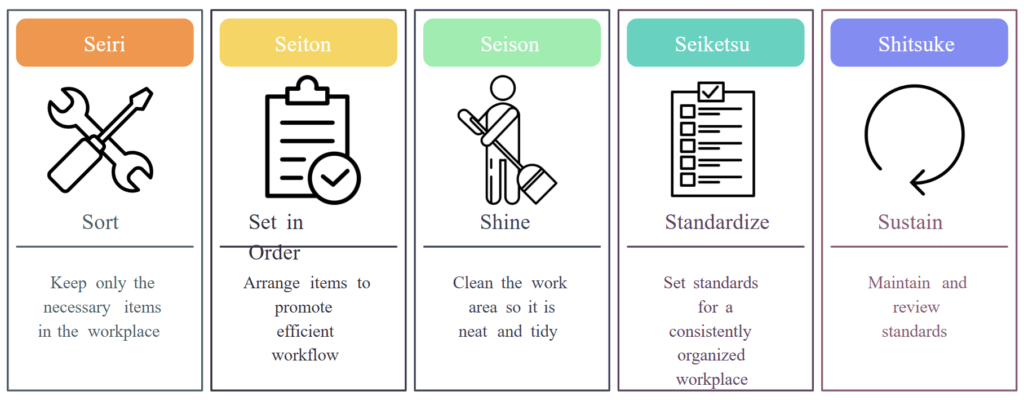
Sort (Seiri)
The first step, Sort, focuses on removing unnecessary items from the workplace. Think of it as decluttering your environment so that only essential items remain. This step is crucial because clutter hides problems and slows down processes. When employees have to navigate through unnecessary tools or materials, it increases errors and reduces efficiency.
A common technique used in this phase is red tagging, where unnecessary items are marked and removed. This simple yet effective method helps teams quickly identify what is needed and what isn’t. Over time, this creates a cleaner and more focused workspace. The goal is not just to clean but to create clarity—so employees can concentrate on what truly matters.
Set in Order (Seiton)
Once unnecessary items are removed, the next step is, Set in Order, or we can say to arrange necessary items so they are easy to access. This step ensures that everything has a designated place and is easily accessible. Imagine a toolbox where each tool has its own labeled slot—you can instantly find what you need without wasting time.
This step significantly reduces motion waste and improves workflow. Studies show that organizing tools and materials properly can drastically reduce time spent searching, which directly impacts productivity. The principle here is simple: “A place for everything and everything in its place.”
Shine (Seiso)
The third step, Shine, it means clean the workplace and maintain hygiene.—it’s about inspection. When employees clean their workspace regularly, they are more likely to notice issues like leaks, damages, or defects early.
This proactive approach helps prevent bigger problems down the line. For example, regular cleaning can reduce defects and improve product quality. It also creates a safer work environment by eliminating hazards. A clean workplace is not just visually appealing—it directly contributes to operational efficiency and safety.
Standardize (Seiketsu)
After implementing the first three steps, the next challenge is maintaining consistency. This is where Standardize comes into play. It involves creating procedures, checklists, and visual controls to ensure that everyone follows the same practices.
Standardization eliminates confusion and ensures that improvements are sustained. For instance, color-coded labels, visual boards, and standard operating procedures help employees quickly understand processes. This step transforms individual efforts into a system-wide practice, making efficiency a habit rather than an exception.
Sustain (Shitsuke)
The final step, Sustain, is often the most challenging. It focuses on maintaining discipline and ensuring that the 5S practices continue over time. Without this step, all previous efforts can quickly fade away.
Sustain requires continuous training, audits, and employee involvement. It’s about creating a culture where organization and efficiency become second nature. Organizations that succeed in this step often see long-term transformation, while those that fail usually revert to old habits.
Key Benefits of 5S Implementation
Productivity Improvement
One of the biggest advantages of 5S is increased productivity. By eliminating clutter and organizing tools, employees can perform tasks faster and more efficiently. The time saved from searching for items can be redirected toward productive activities, leading to higher output.
Organizations often report significant improvements in workflow after implementing 5S. Tasks become smoother, delays are minimized, and overall efficiency improves. This is why 5S is considered a foundational tool in lean manufacturing.
Waste Reduction
5S plays a critical role in reducing waste, also known as muda in lean terminology. It helps eliminate unnecessary movement, excess inventory, and inefficient processes. By making waste visible, 5S enables organizations to address inefficiencies effectively.
This reduction in waste not only improves efficiency but also lowers costs. Businesses can save money on materials, storage, and labor, making 5S a cost-effective solution for operational improvement.
Safety Enhancement
A well-organized workplace is a safer workplace. 5S reduces hazards by removing obstacles, organizing tools, and maintaining cleanliness. Clear pathways, labeled areas, and regular cleaning help prevent accidents and injuries.
Safety improvements also boost employee confidence and morale. When employees feel safe, they are more likely to perform better and contribute positively to the organization.
Real-World Applications of 5S
Manufacturing Industry
In manufacturing, 5S is widely used to improve efficiency and reduce waste. It helps organize tools, streamline workflows, and maintain equipment. This leads to faster production cycles and higher quality products.
Manufacturers around the world rely on 5S as a critical step in lean implementation. It creates a foundation for advanced techniques like Just-in-Time production and Total Productive Maintenance.
Offices and Digital Workspaces
5S is not limited to factories—it can also be applied to offices and digital environments. Organizing files, managing emails, and standardizing workflows can significantly improve productivity in office settings.
For example, a well-organized digital workspace can reduce time spent searching for documents and improve collaboration. This shows how versatile 5S is across different industries.
Step-by-Step Implementation of 5S
Planning and Preparation
Successful implementation begins with proper planning. Organizations need to identify areas that require improvement and set clear goals. Training employees is also essential to ensure everyone understands the methodology.
Starting small is often recommended. Implementing 5S in a single area allows teams to learn and refine the process before scaling it across the organization.
Execution Strategy
Once the planning phase is complete, the next step is execution. Teams should follow each step of 5S systematically, involving employees at every stage. Visual tools like labels, charts, and boards can help reinforce the system.
Employee involvement is crucial for success. When employees take ownership of their workspace, they are more likely to maintain the system.
Monitoring and Continuous Improvement
Implementation does not end with execution. Regular audits and reviews are necessary to ensure that the system is maintained. Continuous improvement should be encouraged through feedback and innovation.
Organizations that treat 5S as an ongoing process rather than a one-time project are more likely to achieve lasting success.
Common Challenges in 5S
Resistance to Change
One of the biggest challenges in implementing 5S is resistance from employees. People are often comfortable with existing processes and may be reluctant to adopt new systems. Overcoming this requires effective communication and training.
Lack of Discipline
Maintaining discipline is another major challenge. Without regular follow-up and audits, employees may revert to old habits. This is why the Sustain step is critical for long-term success.
Best Practices for Successful 5S
Implementing 5S successfully requires a strategic approach. Organizations should focus on leadership involvement, employee engagement, and continuous training. Visual management tools and regular audits can also help maintain the system.
Another important practice is celebrating small wins. Recognizing improvements motivates employees and reinforces the importance of 5S. Over time, this builds a culture of continuous improvement.
5S vs Lean vs Kaizen
| Concept | Focus | Purpose |
|---|---|---|
5S |
Organization |
Workplace efficiency |
Lean |
Waste reduction |
Process optimization |
Kaizen |
Continuous improvement |
Long-term growth |
Conclusion
The 5S methodology is more than just a workplace organization tool—it’s a mindset that transforms how businesses operate. By focusing on organization, cleanliness, and discipline, it creates a foundation for efficiency and continuous improvement. Organizations that embrace 5S often experience long-term benefits such as increased productivity, reduced waste, and improved safety.
What makes 5S truly powerful is its simplicity. It doesn’t require complex tools or expensive investments—just a commitment to improvement and discipline. Whether you’re running a factory, managing an office, or organizing your digital workspace, 5S can help you achieve better results.
Frequently Asked Questions (FAQs)
What is the main goal of 5S?
The main goal of 5S is to create an organized, efficient, and safe workplace by eliminating waste and improving workflow.
Is 5S only for manufacturing?
No, 5S can be applied in offices, healthcare, warehouses, and even digital environments.
How long does it take to implement 5S?
It depends on the organization, but initial implementation can take a few weeks, while sustaining it is an ongoing process.
What is the most difficult step in 5S?
Sustain is considered the most challenging because it requires continuous discipline and commitment.
Can small businesses use 5S?
Yes, 5S is simple and cost-effective, making it suitable for businesses of all sizes.