Basic Quality Control Interview Questions (2026 Guide) Part 1 of 3
This article covers commonly asked basic quality interview questions for freshers, along with simple and clear answers to help you prepare confidently. Whether you are from mechanical, production, or any engineering background, these questions will give you a strong foundation to crack your first quality job interview.
What is Quality and Quality Policy of any organisation?
Quality: The part or product which has been manufactured inside the company, should be fit for use without failure, and as per customer requirement. Quality means “The degree of fineness of any product.”
Quality Policy: To provide complete customer satisfaction through timely delivery of quality product and services based on customer’s feedback with continuous improvement.
What is Quality Control and Quality Assurance?
Quality Control
Quality Control is a part of quality management system which emphasized on fulfilling quality requirement.
Quality Control is a part of quality management which focused that the manufactured part should be within the limit or as per control plan (customer requirement).
Quality Assurance
Quality Assurance is a part of quality management emphasizes on providing confidence that the quality requirement will be fullfilled.
What is the difference between Quality Control and Quality Assurance?
| Quality Assurance | Quality Control |
|---|---|
| Prevent Defects | Identify, Detect Defects |
| Therefore, Proactive Approach | Reactive Approach |
| Cross Fxn Team(CFT): Quality, Prod., Maintenance, Tool room all give input | Dedicated Quality Department Team Works in Quality Control |
| We do periodically Statistical Process Control, Product & Product Audit | Eliminate the defects by QC Tools- Patrol Inspection, Acceptance Sampling |
What is Nominal and Tolerance Size?
| Nominal Size | Tolerance |
|---|---|
| Nominal size is the standard or basic size given to a part. | Tolerance is the limit or allowed variation in Nominal Size. |
| It is the target size used for design | It defines how much actual size can increase or decrease |
| It is usually a rounded or convenient number | Because perfect manufacturing is not possible |
| A shaft is designed as 50 mm = Nominal size | Tolerance = Maximum size – Minimum size |
There are 2 Types of Tolerances
Unilateral Tolerance
- Variation in one direction only
- Example: 50 mm +0.02 / 0
Bilateral Tolerance
- Variation in both directions
- Example: 50 mm ±0.02
Difference (Easy Table)
| Feature | Nominal Size | Tolerance |
|---|---|---|
|
Meaning |
Basic size |
Allowed variation |
|
Purpose |
Design reference |
Manufacturing limit |
|
Example |
50 mm |
±0.02 mm |
What are Jigs and Fixtures?
Jigs
Jig is a tool that guides the cutting tool as well as holds the workpiece.
- 👉 It tells the tool where and how to cut/drill
- A drilling jig used to make holes in the exact same position every time
- It has bushings that guide the drill bit
➡️ Guides the tool + holds the workpiece
Fixtures
Fixture is a tool that only holds and supports the workpiece in the correct position.
👉 It does NOT guide the tool
A milling fixture that holds a part firmly while machining
- A welding fixture that keeps parts aligned
- ➡️ Holds the workpiece only
Difference between Jigs & Fixtures
| Jigs | Fixtures |
|---|---|
|
Hold & Position the work-piece and guide the cutting tool. |
Hold & Position the work-piece but not guide the cutting tool. |
|
Not fixed on work table. |
Fixed on work table. |
|
Use for lighter work. e.g. Drilling, Boring, Reaming, Tapping. |
Use for heavy work e.g. Milling, Grinding, Shaping, Slotting. |
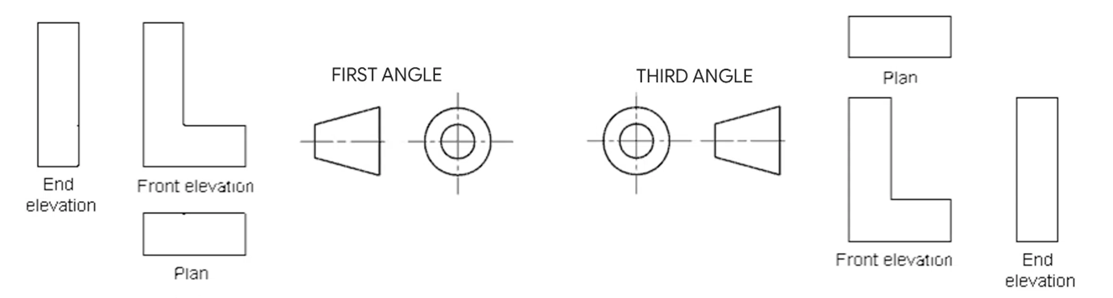
What is the difference between First Angle Projection and Third Angle Projection?
| First Angle Projection | Third Angle Projection |
|---|---|
|
Object imagine in 1st Quadrant |
Object imagine in 3rd Quadrant |
|
Top view comes below the front view |
Top view comes above the front view |
|
Right side view drawn to the left side of elevation |
Right side view drawn to the right side of elevation |
Types of Inspection Method?
There are 2 types of inspection methods.
Attribute Method
Attribute Method: Measurements through gauges which define OK or NOT OK. Examples: Plain Plug Gauges, Snap Gauges.
Variable Method
Variable Method: measurement by instruments which define measurement values. Examples: Vernier Caliper, Micrometer, Bevel Protector.
What is Least Count?
It is a minimum value which an instrument can measure.
📏 Ruler
- Smallest division = 1 mm
- 👉 Least count = 1 mm
🔧 Vernier Caliper
- Can measure up to 0.01 cm (or 0.1 mm)
👉 Least count = 0.01 cm
⚙️ Micrometer Screw Gauge
- Very precise
👉 Least count = 0.001 cm
Types of Errors in Any Instrument?
Positive Error and Negative Error describe whether your measured value is higher or lower than the true value.
| Positive Error | Negative Error |
|---|---|
|
We will minus from Actual Reading |
We will add in Actual Reading |
|
Error value is positive (+) |
Error value is negative (−) |
Positive Error
True value = 50 mm
Measured value = 52 mm
Error = 52 − 50 = +2 mm  Instrument is over-reading
Negative Error
Measured value = 48 mm
Error = 48 − 50 = −2 mm
👉 Instrument is under-reading
What is GD&T?
GD&T (Geometric Dimensioning and Tolerancing) is a symbolic language used in engineering drawings to control the shape, position, orientation, and accuracy of a part.
Simple Interview Definition
“GD&T is used to define the allowable variation in a component so parts can fit and function properly during assembly.”
Practical Example:
- A shaft may have the correct diameter but still be slightly bent.
- GD&T helps control such issues so the shaft rotates smoothly inside a bearing.
Slip Gauges, Feeler Gauges, Spirit Level
Slip Gauges
Slip gauges (also called gauge blocks or Johansson gauges) are precision measuring blocks used to obtain very accurate dimensions.
Different blocks can be joined together (“wrung”) to create an exact required size.
- They are made of hardness steel, ceramic, or carbide.
- Precise measurement of length
- To check the accuracy or to calibrate Vernier Caliper, Micrometer, Slip gauges etc.
- 1.001 mm to 90 mm of size variation.
- High degree of surface finish, flatness, and accuracy.
- Wringing action for joining slip gauges and sliding action to make it separate.
- Measurement of angle by using slip gauges with the help of SINE BAR.
- Used in metrology labs and industries
Feeler Gauges
Feeler gauges are thin metal strips, which are used to measure small clearance or gap between 2 parts.
Examples:
- Spark plug gap
- Valve clearance
- Piston cylinder clearance
- Quality Control: Ensuring proper fitting and alignment
If two metal parts should have a gap of 0.20 mm, a 0.20 mm feeler gauge blade is inserted to check whether the gap is correct.
There blade ranges from 0.02 mm to 1.00 mm (metric type).
Spirit Level
A spirit level is a measuring tool used to check whether a surface is perfectly horizontal (level) or vertical.
It contains a small tube filled with liquid and an air bubble inside.
When the bubble stays in the center between the marked lines, the surface is level.
The liquid is low viscous or can be alcohol.
Uses:
- Construction work
- Carpentry
- Machine installation
- Furniture alignment
- Wall mounting
Difference Between Drilling, Boring and Reaming.
| Drilling | Boring | Reaming |
|---|---|---|
| To originate a hole | To enlarge the dia (Ø) of existing hole | To finish hole’s surface & to improve tolerance. |
| Cutting Tool: Drill Bit | Boring Bar | Reamer |
| Drill is double point cutting tool | It is a single point cutting tool | It is a multi point cutting tool |
| Material Removal Rate (M.R.R.) is higher | MRR is lower as compared to Drilling | MRR is very less. However, it’s not an issue |
| Surface quality of hole is poor | Here it is better than Drilling | Highly surface finish |
| Drill can increase the length of the hole but not the dia Ø | Boring can increase the Ø of the hole but not the length | Reaming can neither increase the Ø nor the length |
| First phase of hole | Pre-drilled hole is mandatory | Similar to boring, hole must required |
What will you do if you find a defect in production?
- Stop the process
- Inform supervisor
- Identify root cause
- Take corrective action
- Prevent recurrence