Intermediate Quality Control Interview Questions (2026 Guide) Part 2 of 3
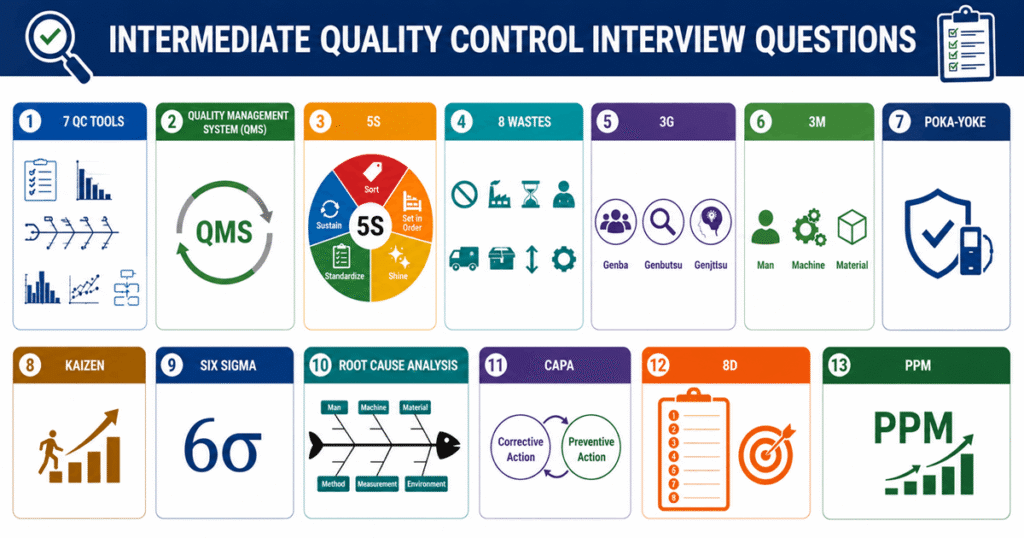
In this article, we will cover important Intermediate Quality Control Interview Questions related to 7 QC Tools, Quality Management System (QMS), 5S, 8 Wastes, 3G, 3M, Poka-Yoke, Kaizen, Six Sigma, Root Cause Analysis, CAPA, 8D, and PPM. These questions will help freshers as well as experienced professionals prepare confidently for quality engineering and quality assurance interviews in manufacturing industries.
admin
What are 7-QC Tools?
- Check Sheet
- Control Charts
- Fishbone or Cause & Effect Diagram
- Histogram
- Parato Chart
- Scatter Diagram
- Statification
What is Quality Management System?
- Quality: The degree of fineness of any product.
- Management: Activities to direct and control any organisation.
- System: Set of an interacting activities.
QMS: It is a set of interacting activities that direct and control an organisation with regards to quality of the product and services.
QMS is a structured collection of
- Policies (Quality Policy, Environmental Policy, Safety Policy),
- Procedures (for NPD, Marketing, Purchase, Recruitment, Rework),
- Processes and there associated responsibilities.
After defining responsibilities of policies, procedures, and processes, we can apply for certification:
- ISO 9001:2016
- IATF 16949:2016 (Automotive Industry),
2016 means company follows their rules, parameters of standard up to 2016.
Then Audits- NCs- Clear NCs- Re-Audit-Get Certification
Advantages of Quality Management System (QMS)
- QMS gives us a confidence and a positive image of the company in the market.
- We can market our product globally.
- QMS assigns the roles and responsibilities of each person and department.
- QMS simplifies the system to take corrective and preventive action against defect.
- It helps us to provide customer satisfaction.
- Cut down the cost and reduce wastages.
- QMS gives us clarity, how we can improve our system based on measured records.

What are 5S?
5S is a Japanese concept. It is a housekeeping system in order to achieve high level of quality, safety so that worker must have excellent working environment.
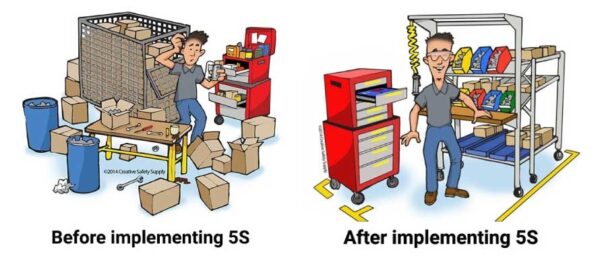
- Sort (Seiri): Remove unnecessary items from the workplace. Keep only what is needed.
- Set in Order (Seiton): Arrange tools and materials in a neat and organized way for easy access.
- Shine Seiso: Arrange tools and materials in a neat and organized way for easy access.
- Standardize (Seiketsu): Create standard procedures to maintain consistency in the first 3 steps.
- Sustain (Shitsuke): Follow and maintain the standards continuously with discipline.
In simple words, 5S helps create a clean, organized, and efficient working environment, which directly improves quality and productivity.
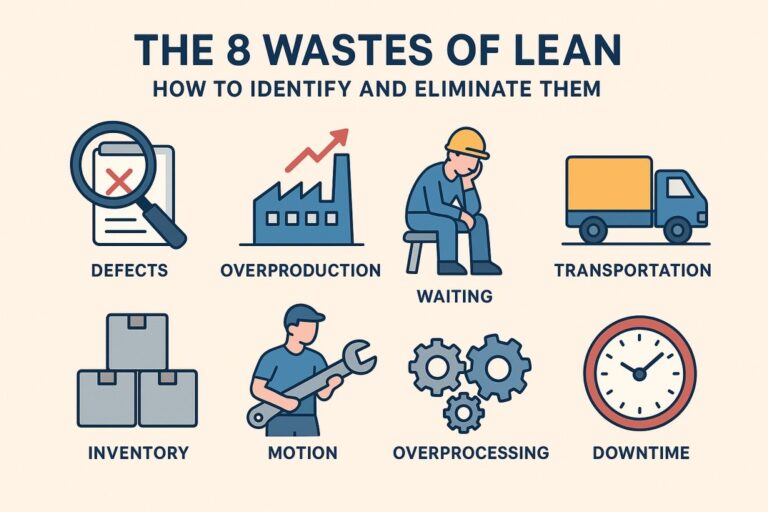
What are 8 Wastes of Lean?
- Extra processing,
- Extra movement of men-power,
- More inventory,
- Over production,
- Rework,
- Transportation,
- Waiting,
- Untilized men-power
What are the 3Gs?
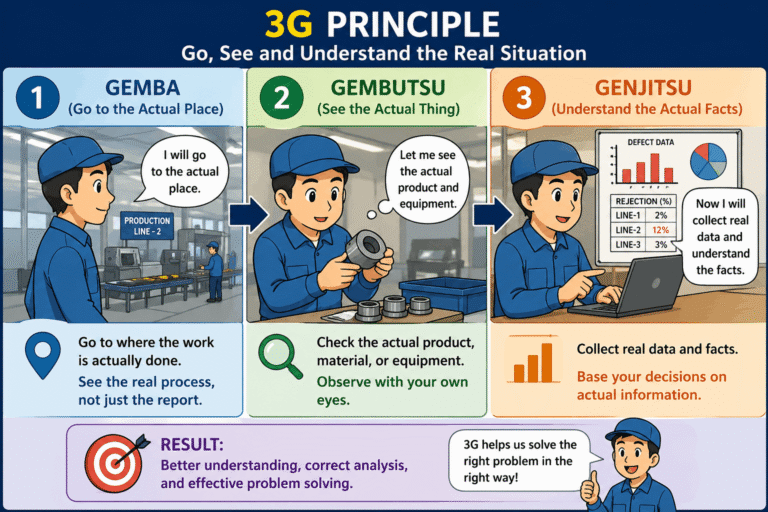
- Gemba (Actual Place) : Go to the spot
- Gembutsu (Actual Thing): See the actual problem
- Genjitsu (Actual Fact/ Data): Take real data and facts about the problem.
1. Gemba (Actual Place)
Go to the real location where the problem occurred (shop floor, production line, site).
👉 Example: Visit the machine where defects are happening instead of analyzing from the office.
2. Gembutsu (Actual Thing)
Check the actual product, material, or equipment involved in the problem.
👉 Example: Inspect the defective part physically instead of relying only on reports.
3. Genjitsu (Actual Facts/Data)
Collect real data and facts about the problem.
👉 Example: Check defect records, measurements, and production data.
Why 3G is Important and its example?
- Prevents assumptions and guesswork
- Improves accuracy in root cause analysis
- Helps make data-driven decisions
- Supports tools like 8D, 5M, and Lean
If there is a defect in production:
- Gemba → Go to the production line
- Gembutsu → Examine the defective product
- Genjitsu → Check actual data and measurements
What are 3M of Lean?
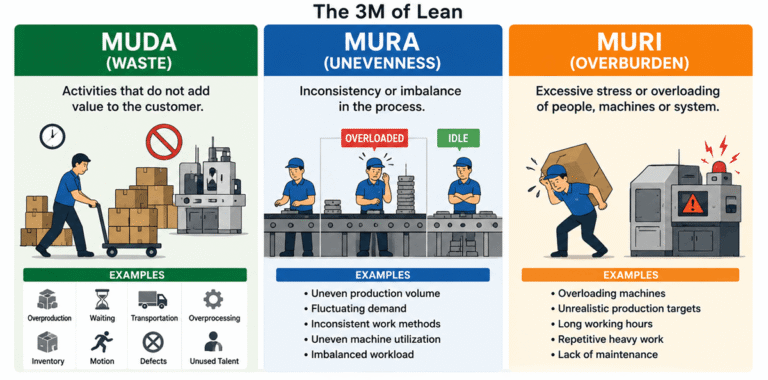
In Lean Manufacturing and Quality Management, Muda, Mura, and Muri are known as the 3M of Lean. They represent the main causes of inefficiency and poor productivity.
1. Muda (Waste)
Muda means activities that do not add value to the customer.
Examples of waste (8 wastes) include:
- Overproduction
- Waiting
- Transportation
- Extra processing
- Inventory
- Motion
- Defects
- Unused talent
Example: Producing more parts than required creates inventory waste.
2. Mura (Unevenness)
Mura means inconsistency or imbalance in production or workflow.
Examples:
- Sudden increase in workload
- Uneven production schedules
- Irregular machine utilization
Example: One operator is overloaded while another is idle.
3. Muri (Overburden)
Muri means excessive stress or overloading of people, machines, or systems.
Examples:
- Workers doing repetitive heavy tasks continuously
- Machines running beyond capacity
- Unrealistic production targets
Example: Running a machine continuously without maintenance causing breakdowns.
Reducing all three helps improve productivity, quality, safety, and efficiency in manufacturing processes.
What is POKA-YOKE?
Poka-Yoke is a Japanese quality concept that means “mistake-proofing” or “error prevention.”
It is used to design processes, tools, or systems in a way that prevents human errors or immediately detects mistakes before defects are produced.
Fool Proofing or Mistake proofing method in process so that no chance of defect occurs.
The main goal of Poka-Yoke is:
- Prevent defects
- Improve quality
- Reduce rework and rejection
- Increase process reliability
Examples of Poka-Yoke
- USB can be inserted only in one direction
- Car seatbelt warning alarm
- SIM card tray fitting in only one position
- Fixture that allows a part to be placed correctly only one way
Types of Poka-Yoke
1. Prevention Type
Stops the mistake from happening.
Example: Connector that fits only correctly.
2. Detection Type
Detects the mistake before the next process.
Example: Sensor detecting missing components.
Benefits of Poka-Yoke
- Reduces human error
- Improves product quality
- Saves cost and time
- Reduces customer complaints
What is Kaizen?
Kaizen is a Japanese term that means “continuous improvement.” or Kaizen is a Japanese concept, which means small changes in the system for betterment or continual improvement.
It is a quality and productivity improvement approach where small, ongoing changes are made to processes, machines, methods, or workplace practices to improve efficiency, quality, and safety.
Kaizen focuses on:
- Eliminating waste
- Improving productivity
- Reducing defects
- Saving time and cost
- Involving employees in improvement activities
Example: If workers rearrange tools near the workstation to reduce walking time, it is considered a Kaizen improvement.
Benefits of Kaizen
- Better quality
- Higher productivity
- Reduced waste
- Improved safety
- Employee engagement
What is PPM?
PPM in manufacturing stands for Parts Per Million. PPM means how many parts are rejected per million (10,00000).
Formula to calculate PPM:

Example:
- Total parts produced: 500,000
- Defective parts: 25
- PPM=(25/500,000) X 1,000,000=50
Result: The manufacturing process has 50 PPM, meaning there are 50 defective parts for every one million parts produced.
Why PPM is important?
Manufacturers use PPM to:
- Measure product quality.
- Monitor process performance over time.
- Compare supplier quality.
- Set customer quality targets (for example, less than 100 PPM).
Typical PPM Levels:
| PPM | Quality Level |
|---|---|
| 10,000 | Poor (1% defects) |
| 1,000 | Fair (0.1% defects) |
| 100 | Good (0.01% defects) |
| 10 | Excellent |
| 3.4 | World-class Six Sigma quality (approximately 3.4 defects per million opportunities under Six Sigma assumptions) |
What is Root Cause Analysis?
It is used to analysis the Root Cause of the problem. It helps to determine:
- Who discovered the problem?
- What exactly happened?
- Where in the process was the problem discovered?
- When was the problem discovered?
- How many / How often does it happen?
- How was the problem detected?
There are mainly 2 types of method to find the root cause of any problem.
- Ishikawa Diagram/ Fish Bone Diagram
- 5 Why Analysis
Ishikawa Diagram/ Fish Bone Diagram
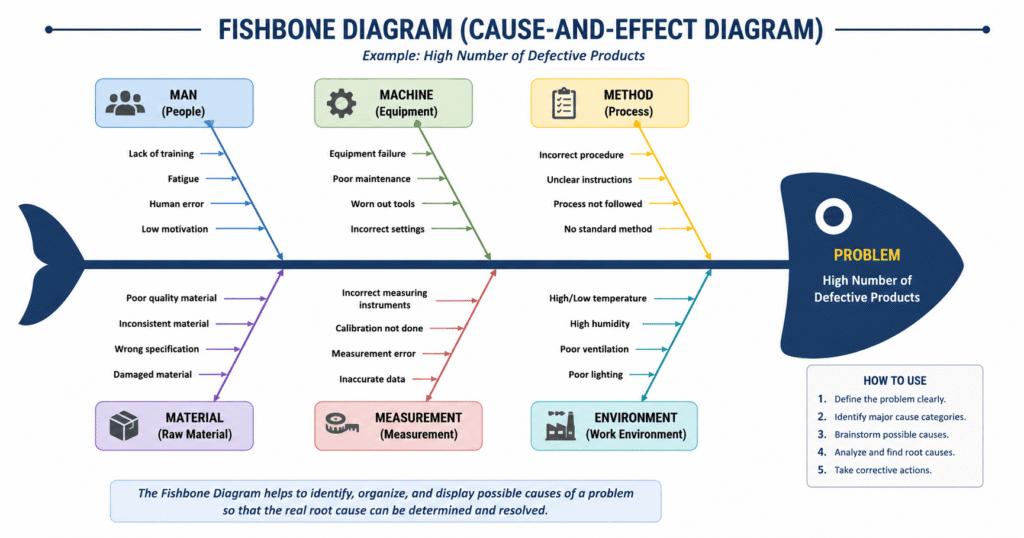
The Ishikawa Diagram, also called a Fishbone Diagram, is a problem-solving tool used to identify the possible causes of a quality problem.
It is called a Fishbone Diagram because it looks like the skeleton of a fish. The problem or effect is written at the end of the diagram, and the possible causes are shown as the fish’s “bones.”
The 6Ms
The main categories of causes are commonly divided into the 6Ms:
- Man (People) – Skills, training, or human errors
- Material – Quality or type of raw materials
- Method – Procedures, processes, or work instructions
- Machine – Equipment, tools, or machine problems
- Measurement – Measuring methods, instruments, or data
- Mother Nature (Environment) – Temperature, humidity, workplace conditions, etc.
How does it work?
The diagram is usually developed from right to left:
- Write the problem at the end of the diagram.
- Identify the main cause categories (6Ms).
- Brainstorm all the possible causes.
- Add smaller causes under each main category.
- Do not reject an idea during brainstorming. Record all possible causes first and review them later.
Selecting the Root Causes
After identifying all possible causes, the team should:
- Review and evaluate the possible causes.
- Rate them based on their importance and likelihood of causing the problem.
- Create a hierarchy or priority list of the causes.
- Select the most likely causes for further investigation.
- Use data or evidence to confirm the actual root cause.
The Ishikawa Diagram helps teams organize ideas, understand the possible causes, and focus their investigation on the most likely causes of a problem.
5-Why Analysis
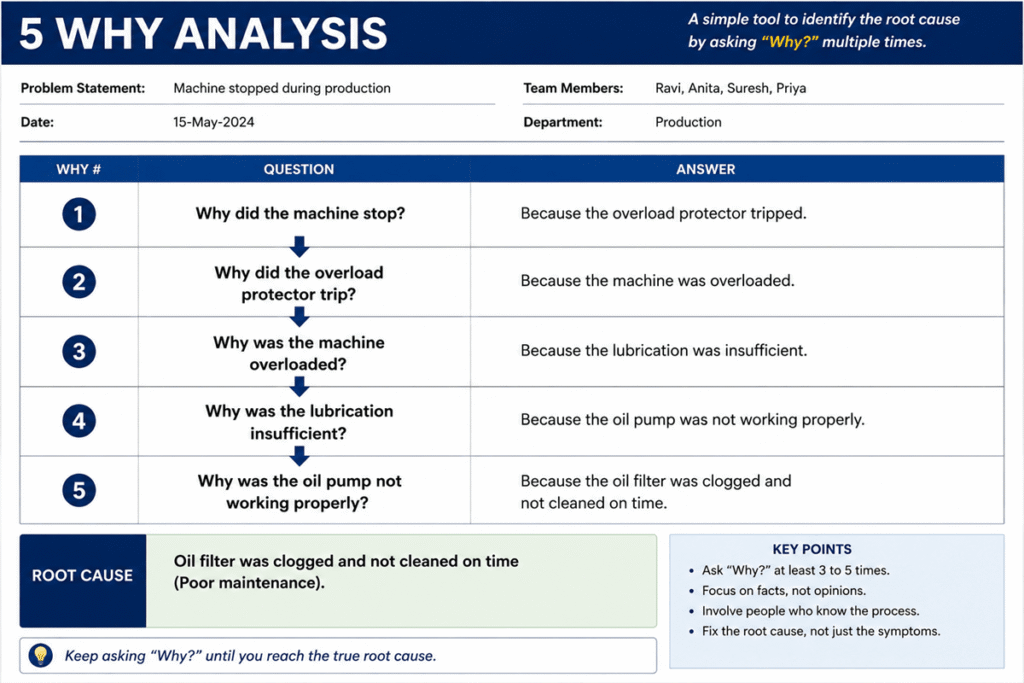
The 5 Why method is a simple problem-solving technique used to find the root cause of a problem.
It works by asking “Why?” repeatedly until you reach the actual reason behind the problem, rather than just fixing its symptoms.
How does it work?
- Start with the problem.
- Ask “Why did this happen?”
- Take the answer and ask “Why?” again.
- Continue asking why, usually 3 to 5 times.
- The final answer should help identify the root cause.
Where is it used?
The 5 Why method is commonly used for problem-solving and root-cause analysis.
It can be used:
- By itself, or
- Together with other tools, such as the Fishbone (Cause-and-Effect) Diagram.
The method works best when the answers come from people who have direct, hands-on experience with the problem.
3 areas that can be checked
Sometimes, the 5 Why analysis looks at three different areas:
- Why did the problem occur?
- Why was the problem not detected?
- Why did our system fail to prevent it?
There may be more than one root cause in each area.
What is Six Sigma?
PPM in manufacturing stands for Parts Per Million. PPM means how many parts are rejected per million (10,00000).
Formula to calculate PPM:
Example:
- Total parts produced: 500,000
- Defective parts: 25
- PPM=(25/500,000) X 1,000,000=50
Result: The manufacturing process has 50 PPM, meaning there are 50 defective parts for every one million parts produced.
What is ISO certification?
ISO certification is formal recognition that an organization, product, service, or process meets the requirements of a specific ISO (International Organization for Standardization) standard.
For example:
- ISO 9001 — Quality Management System (QMS)
- ISO 14001 — Environmental Management System
- ISO 45001 — Occupational Health & Safety
- ISO/IEC 27001 — Information Security Management System
- ISO 22000 — Food Safety Management System
How certification works
Typically, an organization:
- Implements the requirements of the chosen ISO standard.
- Documents its processes and controls.
- Undergoes an audit by an independent certification body.
- If it meets the requirements, the certification body issues an ISO certificate.
- The organization undergoes periodic surveillance audits to maintain certification.
Important: ISO itself generally does not issue certificates to companies. Certification is performed by independent certification bodies.
In simple terms, ISO certification shows that an organization has a structured system that has been independently assessed against an internationally recognized standard.
What are the 5Ms?
The 5M categories help you systematically analyze where a problem might come from:
1. Man (People)
Human-related factors:
- Skill level
- Training
- Human error
- Fatigue or lack of attention
👉 Example: Operator not properly trained
2. Machine (Equipment)
Equipment or tools used in the process:
- Machine breakdown
- Calibration issues
- Maintenance problems
👉 Example: Machine not calibrated correctly
3. Material
Raw materials or components:
- Poor quality material
- Wrong specifications
- Supplier issues
👉 Example: Defective raw material supplied
4. Method (Process)
The way the work is done:
- Incorrect procedures
- Poor process design
- Lack of standardization
👉 Example: No standard operating procedure (SOP)
5. Measurement
Inspection and data-related issues:
- Incorrect measuring tools
- Wrong data collection
- Calibration errors
👉 Example: Faulty measuring instrument
6. Mother Nature
Sometimes industries expand this to 6M by adding:
- Mother Nature (Environment) → temperature, humidity, etc.
Why 5M is Important and its examples?
- Helps find root causes systematically
- Prevents missing important factors
- Improves problem-solving accuracy
- Supports tools like 8D, Six Sigma, and Lean
If a product defect occurs:
- Check Man → Was the worker trained?
- Check Machine → Is the machine working properly?
- Check Material → Is the raw material good?
- Check Method → Is the process correct?
- Check Measurement → Are results measured accurately?
What is 8 Disciplines (8D)?
8 Disciplines are method for problem solving. Every “D” has its own significant importance.
D1 – Team Formation: We will define C.F.T. (Cross Functional Team) of people with the right knowledge and skills related to problem.
D2 – Problem Description: Clearly describe the issue using data:
- What is wrong?
- Where did it occur?
- When did it happen?
- How big is the impact?
D3 – Implement Interim Containment Action:
Take temporary actions to protect the customer from the problem (e.g., sorting defective products, 100% inspection at customer’s end).
D4 – Root Cause Analysis:
Find the real cause of the problem (not just symptoms) using tools like:
- 5 Whys,
- Fishbone/ Ishikawa Diagram
D5 – Corrective Action on Root Cause: Decide on solutions that will permanently fix the root cause.
D6 – Validate the Corrective Action: We will verify the effectiveness of the corrective action which we have taken.
D7 – Implement Preventive Action: Update systems, procedures, or training so the issue does not happen again.
D8 – Team Recognition: Acknowledge the team’s effort and success in solving the problem.
Why 8D is Important?
- Improves product and process quality
- Prevents repeated issues
- Enhances customer satisfaction
- Builds a culture of structured problem-solving
What are the key responsibilities of a Quality Control Inspector?
The key responsibilities of a Quality Control (QC) Inspector typically include:
- Inspecting materials and products – Check incoming raw materials, components, and finished products against specified quality standards.
- Conducting measurements and tests – Use tools such as calipers, micrometers, gauges, testing equipment, or inspection instruments to verify dimensions, performance, and specifications.
- Identifying defects – Detect defects, deviations, or non-conformities and determine whether products meet required standards.
- Following quality standards and procedures – Ensure production complies with drawings, specifications, SOPs, customer requirements, and applicable industry standards.
- Documenting inspection results – Maintain inspection reports, checklists, test records, defect reports, and other quality documentation accurately.
- Handling non-conforming products – Identify, segregate, and report defective materials or products and support corrective actions.
- Monitoring production processes – Perform in-process inspections to identify quality problems early and prevent defective products from reaching the next stage.
- Using inspection equipment properly – Ensure measuring and testing instruments are correctly used and, where applicable, calibrated.
- Working with production and engineering teams – Communicate quality issues and help investigate the causes of defects and process deviations.
- Supporting continuous improvement – Provide feedback and participate in corrective/preventive actions (CAPA), root-cause analysis, and efforts to reduce defects and improve quality.
In simple terms: A QC Inspector ensures that materials, processes, and finished products meet the required quality standards before they are accepted or delivered to the customer.
What is the importance of documentation in QC?
Documentation is very important in Quality Control (QC) because it provides clear evidence that products and processes meet the required quality standards.
Importance of documentation in QC
- Ensures consistency – Procedures, specifications, and work instructions help employees perform tasks consistently.
- Provides traceability – Records allow the history of a product, batch, test, or process to be traced when problems occur.
- Supports quality assurance – Proper documentation provides evidence that QC tests and inspections were performed correctly.
- Helps identify problems – QC records make it easier to detect trends, deviations, and recurring quality issues.
- Facilitates audits and inspections – Regulatory agencies and auditors can verify compliance using documented records.
- Improves decision-making – Accurate data and test results help management make informed quality-related decisions.
- Supports corrective and preventive actions (CAPA) – Documentation helps determine the cause of failures and track corrective actions.
- Maintains regulatory compliance – In regulated industries such as pharmaceuticals, food, and medical devices, documentation is essential for meeting legal and industry requirements.
- Provides accountability – Records show who performed a task, when it was performed, and what results were obtained.
- Preserves organizational knowledge – Documented procedures and results ensure important knowledge is not lost when employees leave.
In short: “If it isn’t documented, it is difficult to prove that it was done.” Good documentation makes QC consistent, traceable, auditable, and reliable.