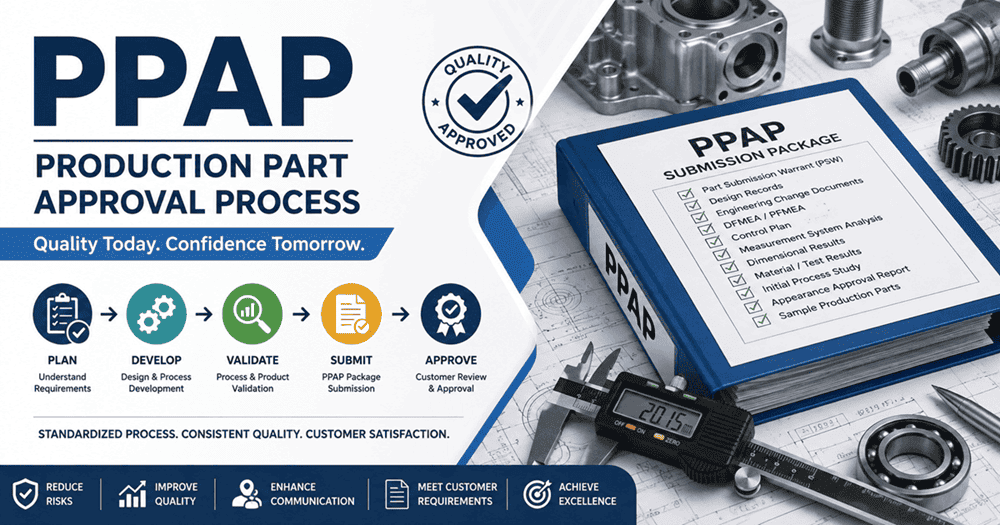
Production Part Approval Process (PPAP): Core Quality Tool
Production Part Approval Process (PPAP) is a formal process used to establish confidence between a supplier and customer before full-scale production begins. Basically, it is a documents which is done by the supplier and reviewed by the customer.
In this guide, you’ll learn everything about PPAP, when it is done, why it is required, and how it is done.
What is Production Part Approval Process (PPAP)?
PPAP is a formal process, before full scale production begins, which tells that the supplier will fulfil the customer requirement and will deliver quality products.
The process verifies that:
- The supplier understands the customer’s design and specification requirements.
- The manufacturing process is capable of producing conforming parts.
- Production processes are properly documented.
- Inspection and testing requirements have been fulfilled.
- The supplier can consistently produce parts at the required quality level.
Production Part Approval Process (PPAP) is particularly important when a new part or process is introduced, or when an existing part undergoes significant changes.
Elements of Production Part Approval Process (PPAP)
Below is the list of all 18 elements accompanied by a brief description for each element:
- Design Records
- Engineering Change Note (ECN)
- Customer Engineering Approval
- Design Failure Mode and Effects Analysis (DFMEA)
- Process Flow Diagram
- Process Failure Mode and Effects Analysis (PFMEA)
- Control Plan
- Measurement System Analysis (MSA) Studies
- Dimensional Results
- Material Performance Test Results
- Initial Process Studies
- Qualifies Laboratory Documentation
- Appearance Approval Report (AAR)
- Sample Product
- Master Sample
- Checking AIDS
- Records of compliance with customer specification requirements
- Part Submission Warrant (PSW)

Brief Explanation of 18 Elements of Production Part Approval Process (PPAP)
Below is the list of all 18 elements accompanied by a barief description for each element:
1. Design Records
Printed copy of the design is to be provided.
- If customer is responsible for drawing then it will be of customer drawing,
- If supplier is responsible for drawing then it will be released by the supplier.
2. Engineering Change Note
Supplier will submit ECN to customer if there is any change in product design parameter that not yet recorded in Design Records.
3. Customer Engineering Approval (if required)
- Customer approval copy of ECN will be submitted.
- Or whatever change we will make in product design parameter, we will take approval from the customer and we will maintain that customer approved copy.
4. Design Failure Mode and Effects Analysis (DFMEA)
If supplier is responsible for design, then the copy of DFMEA will be attached with PPAP which customer will be reviewed & signed-off.
5. Process Flow Diagram (PFD)
- A copy of process flow diagram, indicating all the steps and sequences of production process.
- The Process Flow Diagram outlines the entire process for assembling the component or final assembly in a graphical manner. The process flow includes incoming material, assembly, test, rework and shipping.
6. Process Failure Mode and Effects Analysis (PFMEA)
We will analyse the chances of potential failure within the manufacturing process and then document the applied controls. The PFMEA should be updated anytime, even after the product is in normal production.
7. Control Plan
- It shows step by step which dimension is to be maintained and how, how to check the dimension.
- It tells all the dimensions from Incoming Inspection to Final Inspection.
8. Measurement System Analysis Studies (MSA)
- Measurement System Analysis (MSA) contains Gauge Repeatability & Reproducibility (GR&R) studies on measurement equipment used during assembly or quality control checks.
- Calibration records for all gages and measurement equipment must be included.
9. Dimensional Results
- A list of every dimensions noted on the balloon drawing. it is a layout inspection.
- Dimensional layout of sample parts is required to validate the product meets the print specifications. The samples should be randomly selected from a significant production run usually at least 30 pieces.
10. Records of Material / Performance Tests
Summary of every test performed on the part. e.g. heat treatment test, durability testing, functional testing, or other customer-specified evaluations.
11. Initial Process Studies
Initial process studies will be done on all the production processes and will include Statistical Process Control (SPC). In this we study the Cp & Cpk Value to find the process capability so that the process will remain within specifications.
12. Qualified Laboratory Documentation
Qualified laboratory documentation consists of the industry certifications for any lab that was involved in completing validation testing. That could be external or internal (in-house lab).
13. Appearance Approval Report (AAR)
An Appearance Approval Report (AAR) may be required. Product appearance will be approved by the customer. It confirms the colour, grain, texture etc prior to production part submission.
14. Product Sample
It shows a picture of the product where it is kept or stored.
15. Master Sample
Supplier retains a Master (final) Sample which is approved (signed) by the customer. It is used to train the operators and serves as a benchmark for comparison.
16. Checking Aids
- Any special tools for checking parts. Example fixtures, variables & attributes gauges, models. We will show their calibration records and dimensional reports.
- MSA may be required for all checking aids based on customer requirements.
17. Records of compliance with customer specific requirements
This element of the submission package is where any special customer requirements are contained. For bulk materials, the customer specific requirements shall be recorded on the “Bulk Material Requirements Checklist”.
18. Part Submission Warrant (PSW)
- The Part Submission Warrant (PSW) form is a summary of the entire PPAP submission.
- It gives confirmation to the organisation that we will submit only approved part. No other part will be shipped or no other changed will be made without approval.
- If product is assembled, then there are different part PSW will be submitted separately for each part.
PPAP documentation can be submitted at different levels depending on customer requirements.Level 3 is one of the most commonly used PPAP submission levels.
- Level 1: Only PSW is submitted to the customer,
- Level 2: PSW with Product Samples + Limited Supporting Data
- Level 3: PSW with Product Samples + Complete Supporting Data
- Level 4: PSW + other required docs defined by the customer
- Level 5: PSW + Sample + Complete Data available for review.
PPAP Submission Status
- Full Approval: Suppliers can start the production & supply the approved product. And can retain the PPAP till product is active.
- Interim Approval: Part can supply for a limited time or limited quantity only.
- Reject: Correct product and documentation should be submitted before the supply start.
Conclusion
The Production Part Approval Process (PPAP) process is a detailed and lengthy process. The PPAP package includes documentation of various multiple cross-functional tools and documents the ability of the supplier to meet all customer requirements. PPAP provides customers adequate information to validate that all areas of the design and production processes have been reviewed thoroughly to ensure that only high quality products will be allowed to ship to the end customer.
Frequently Asked Questions (FAQs)
What is Production Part Approval Process (PPAP)?
Production Part Approval Process (PPAP) defines the approval process for new or revised parts, or parts produced from new or significantly revised production methods. The PPAP process consists of 18 elements that may be required for approval of production level parts. Not all of the elements are required for every submission. There are five generally accepted PPAP submission levels. The PPAP manual contains detailed information, guidelines and sample documents useful for completing the process requirements. The resulting PPAP submission provides the evidence that the supplier has met or exceeded the customer’s requirements and the process is capable of consistently reproducing quality parts.
Why Perform Production Part Approval Process (PPAP)?
The Production Part Approval Process (PPAP) process verifies that the supplier understands all customer engineering design specifications and requirements and that the process is capable of consistently producing product meeting those requirements during an actual production run at the quoted production rate. PPAP and other quality tools continue to be implemented into more industries; therefore it is important to gain an understanding of the PPAP requirements to remain competitive as a parts supplier.
When to Perform Production Part Approval Process (PPAP)?
A Production Part Approval Process (PPAP) is required for any new part submission as well as for approval of any change to an existing part or process. The customer may request a PPAP at any time during the product life. This demands that the supplier must maintain a quality system that develops and documents all of the requirements of a PPAP submission at any time.
How to Perform Production Part Approval Process (PPAP)?
The process of completing a Production Part Approval Process (PPAP) submission is fairly complex. This detailed process is a collection of key elements that must be completed to verify that the production process will produce a quality product. Not all of the elements are always required for a PPAP submission. The particular requirements of the PPAP are usually negotiated during the quoting process.
Also checkout other quality related article:
- Statistical Process Controls (SPC)
5S Methodology: The Ultimate Guide to Building an Organised and Efficient Workplace
Measurement System Analysis (MSA)