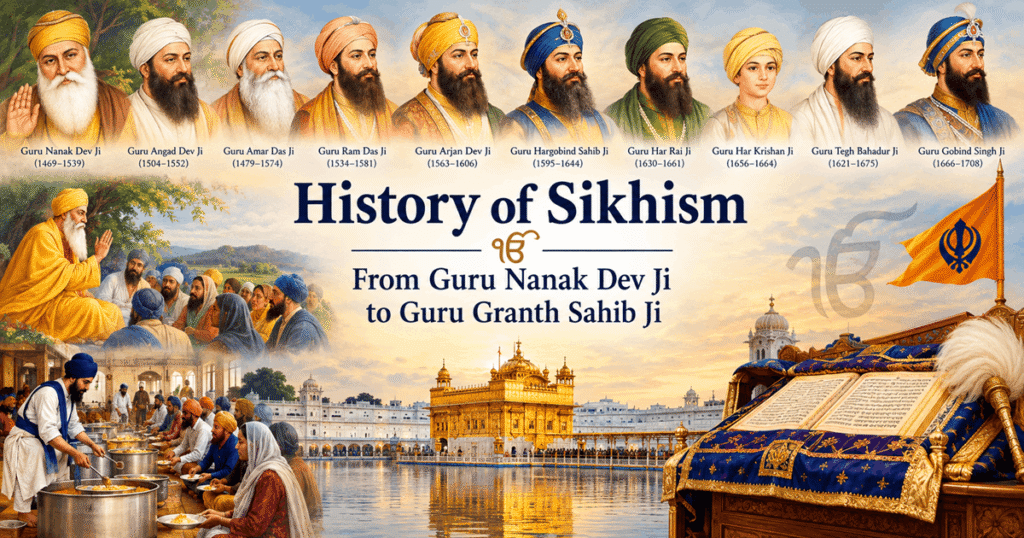
History of Sikhism: From Guru Nanak Dev Ji to Guru Granth Sahib
Discover the history of Sikhism from Guru Nanak Dev Ji and the ten Sikh Gurus to the creation of the Khalsa and the final Guruship of Sri Guru Granth Sahib Ji. Explore the teachings, institutions, sacrifices, and major events that shaped the Sikh faith over nearly 250 years.
admin
Sikhism emerged in the Punjab region of South Asia during the late 15th century through the spiritual teachings of Guru Nanak Dev Ji (1469–1539). Over the next two centuries, the Sikh tradition developed under the guidance of ten Gurus. They established a spiritual path centered on devotion to the One God, truthful living, equality, honest work, service, and remembrance of the Divine.
The period from Guru Nanak Dev Ji to Guru Gobind Singh Ji witnessed the formation of Sikh institutions, communities, places of worship, literary traditions, and eventually the Khalsa. The culmination of this historical development came when Guru Gobind Singh Ji ended the succession of human Gurus and vested the eternal Guruship in Sri Guru Granth Sahib Ji.
Table of Contents
ToggleThe Origins of Sikhism
Sikhism began in the Punjab region in the 15th century. At the center of its teachings was the realization that there is One Supreme Reality, expressed in the opening declaration of Sikh scripture:
Ik Onkar — One Universal Creator.
Guru Nanak Dev Ji taught that spiritual life was not limited to ritual, pilgrimage, caste, or religious identity. Instead, human beings should remember God, live honestly, share with others, serve humanity, and overcome ego.
The Sikh community that developed around his teachings became known as the Sangat, a community gathered around the Guru’s teachings.
Guru Nanak’s message emphasized three principles that remain central to Sikh life:
- Naam Japna — remembering and meditating on the Divine Name
- Kirat Karni — earning an honest living
- Vand Chakna — sharing one’s earnings and resources with others
His teachings challenged social discrimination and emphasized the spiritual equality of human beings.
Guru Nanak Dev Ji (1469–1539)
Guru Nanak Dev Ji was born in 1469 at Rai Bhoi Ki Talwandi, now known as Nankana Sahib in present-day Pakistan.
From an early age, Guru Nanak displayed a deep interest in spiritual questions. According to Sikh tradition, his spiritual awakening led him to devote his life to teaching humanity about the One God and the importance of truthful living.
He traveled extensively, accompanied in tradition by his companion Bhai Mardana, visiting different regions and engaging with people of different religious and social backgrounds.
Guru Nanak’s teachings were expressed through poetry and devotional music. His compositions became an important foundation of Sikh scripture.
He eventually established a community at Kartarpur, where people gathered to listen to his teachings, sing hymns, work, and share food.
Rather than establishing a hereditary religious dynasty, Guru Nanak selected Bhai Lehna, later known as Guru Angad Dev Ji, as his successor. This established the principle that spiritual leadership was based on devotion and commitment to the Guru’s teachings rather than simply family inheritance.
Guru Nanak Dev Ji passed away in 1539.
Guru Angad Dev Ji (1504–1552)
The second Guru was Guru Angad Dev Ji, born Lehna Ji.
Guru Angad continued Guru Nanak’s teachings and played an important role in strengthening the developing Sikh community.
One of his major contributions was the development and standardization of the Gurmukhi script, which became the principal script used for recording Sikh scripture and Punjabi literature.
Guru Angad also emphasized physical discipline, education, community life, and service.
He preserved and transmitted the hymns associated with Guru Nanak while composing his own Gurbani.
Guru Angad Dev Ji appointed Amar Das Ji as his successor.
Guru Amar Das Ji (1479–1574)
Guru Amar Das Ji, the third Guru, expanded Sikh institutions significantly.
He strengthened the tradition of Langar, the community kitchen in which people from different social backgrounds could sit together and share a meal.
Langar became much more than a meal. It represented the Sikh principle of equality and challenged social divisions based on caste and status.
Guru Amar Das Ji also established preaching centers and encouraged the growth of Sikh communities in different areas. His period saw the Sikh community becoming more organized and increasingly independent as a religious tradition.
Guru Amar Das Ji selected Bhai Jetha Ji, later known as Guru Ram Das Ji, as his successor.
Guru Ram Das Ji (1534–1581)
Guru Ram Das Ji was the fourth Sikh Guru.
He continued developing the Sikh community and is closely associated with the establishment of Ramdaspur, which eventually became Amritsar.
The sacred pool around which the central Sikh shrine developed became an important center of Sikh religious life.
Guru Ram Das Ji also composed numerous hymns. His compositions became part of Sikh scripture and remain central to Sikh devotional practice.
His son, Guru Arjan Dev Ji, succeeded him as the fifth Guru.
Guru Arjan Dev Ji (1563–1606)
Guru Arjan Dev Ji, the fifth Guru, played one of the most important roles in the development of Sikh history.
During his leadership, Harmandir Sahib at Amritsar became a major center of Sikh worship.
Perhaps his greatest literary contribution was the compilation of the Adi Granth.
Guru Arjan collected the compositions of the earlier Gurus along with his own compositions and selected writings of spiritually respected figures from different backgrounds. The compilation was written by Bhai Gurdas under Guru Arjan’s supervision.
The Adi Granth was installed at Harmandir Sahib in 1604, with Baba Buddha Ji serving as its first granthi.
This was a defining moment in Sikh history because the community now possessed an authoritative collection of Gurbani.
Martyrdom of Guru Arjan Dev Ji
Guru Arjan Dev Ji was executed in Lahore in 1606 during the reign of Mughal Emperor Jahangir.
His martyrdom had a profound effect on Sikh history. It contributed to a transformation in the Sikh community’s relationship with political authority and defense.
His successor, Guru Hargobind Sahib Ji, introduced an important new dimension to Sikh community life.
Guru Hargobind Sahib Ji (1595–1644)
Guru Hargobind Sahib Ji, the sixth Guru, responded to the changing circumstances faced by the Sikh community.
He emphasized both spiritual and temporal responsibilities, traditionally represented through the concept of Miri-Piri.
The Guru wore two swords symbolizing spiritual and temporal authority and established the Akal Takht at Amritsar.
Under Guru Hargobind, Sikhs increasingly developed the capacity to defend themselves and their communities.
He also maintained the spiritual tradition of the earlier Gurus. Thus, Sikh identity developed around both devotion and responsibility toward justice.
Guru Har Rai Ji (1630–1661)
Guru Har Rai Ji, the seventh Guru, succeeded Guru Hargobind.
He maintained the Sikh community’s institutions while emphasizing compassion, humility, service, and spiritual discipline.
Guru Har Rai Ji also maintained an organized Sikh missionary network and continued spreading the teachings of the Gurus.
His period was comparatively peaceful, although the political environment of the Mughal Empire remained important to Sikh history.
Guru Har Rai Ji appointed his younger son, Guru Har Krishan Ji, as his successor.
Guru Har Krishan Ji (1656–1664)
Guru Har Krishan Ji became the eighth Guru at a very young age.
His Guruship was brief. He is remembered particularly for his compassion and service to people suffering during an epidemic in Delhi.
Guru Har Krishan Ji died in Delhi in 1664.
Before his death, Sikh tradition records that he indicated “Baba Bakala”, pointing toward the location where his successor would be found.
The successor was Guru Tegh Bahadur Ji.
Guru Tegh Bahadur Ji (1621–1675)
Guru Tegh Bahadur Ji, the ninth Guru, was a profound spiritual poet and thinker.
His life included extensive travels through different parts of the Indian subcontinent, where Sikh communities were established and strengthened.
His Gurbani emphasizes themes such as:
- Detachment from worldly fear
- Acceptance of God’s will
- Courage
- Meditation
- Freedom from ego
- The temporary nature of worldly existence
Martyrdom of Guru Tegh Bahadur Ji
One of the most significant events in Sikh and Indian history occurred in 1675.
A group of Kashmiri Pandits approached Guru Tegh Bahadur Ji seeking protection against religious persecution. According to Sikh historical tradition, Guru Tegh Bahadur Ji chose to stand for the principle of religious freedom.
He was executed in Delhi in 1675.
His martyrdom became an important part of Sikh understanding of religious liberty and sacrifice. The SGPC’s historical account describes his sacrifice as being undertaken for the defense of religious freedom and dharma.
His young son, Gobind Rai, became the tenth Guru.
Guru Gobind Singh Ji (1666–1708)
Guru Gobind Singh Ji was the tenth and final human Guru of Sikhism.
His life marked a decisive stage in the formation of the Sikh community.
Creation of the Khalsa
On Vaisakhi in 1699, at Anandpur Sahib, Guru Gobind Singh Ji established the Khalsa.
The founding of the Khalsa created a disciplined community committed to spiritual devotion, equality, courage, and responsibility.
The five original members who volunteered during the famous Vaisakhi ceremony became known as the Panj Pyare, the Five Beloved Ones.
The Khalsa identity became associated with the Five Ks:
- Kesh — uncut hair
- Kangha — wooden comb
- Kara — iron or steel bracelet
- Kachera — prescribed shorts
- Kirpan — ceremonial sword
Guru Gobind Singh Ji also gave the Sikh community a distinctive collective identity, with initiated men traditionally taking the name Singh and women Kaur.
The Battles and Sacrifices of Guru Gobind Singh Ji's Era
The period of Guru Gobind Singh Ji was marked by conflict involving Mughal authorities and regional hill chiefs.
The Guru and his Sikhs experienced several battles and major personal losses.
His four sons are remembered in Sikh history as the Sahibzade.
Sahibzada Ajit Singh Ji
Ajit Singh Ji died fighting at the Battle of Chamkaur.
Sahibzada Jujhar Singh Ji
Jujhar Singh Ji also fought at Chamkaur and died in battle.
Sahibzada Zorawar Singh Ji and Sahibzada Fateh Singh Ji
The younger Sahibzade were captured and executed at Sirhind.
Their grandmother, Mata Gujri Ji, also died during this period.
These events became some of the most powerful examples of sacrifice and courage in Sikh historical memory.
The Zafarnama
During the later years of his life, Guru Gobind Singh Ji wrote the Zafarnama, a letter addressed to Mughal Emperor Aurangzeb.
The letter challenged the emperor’s conduct and emphasized moral responsibility, truth, and justice.
Guru Gobind Singh Ji continued to lead the Sikh community until the final period of his life.
The Final Form of Sikh Scripture
The history of Sikh scripture began with Guru Nanak Dev Ji.
The Gurus preserved and transmitted Gurbani from one generation to the next. Guru Arjan Dev Ji brought a major stage of this process to completion by compiling the Adi Granth in 1604.
The scripture contained compositions of the Sikh Gurus as well as writings of several Bhagats and other spiritually respected figures.
Importantly, the inclusion of these writings demonstrated that spiritual truth was not presented as the exclusive possession of one social group or caste. The scripture contains compositions associated with figures from different social and religious backgrounds.
Guru Arjan’s compilation became the central scriptural authority of the Sikh community.
Guru Tegh Bahadur Ji's Bani Added to the Scripture
After Guru Tegh Bahadur Ji’s martyrdom, his compositions were incorporated into the Sikh scriptural tradition.
During the period of Guru Gobind Singh Ji, the scripture was brought to its final form by incorporating the Gurbani of the ninth Guru. Sources describe this final recension as being prepared at Damdama Sahib.
The resulting scripture is known as Sri Guru Granth Sahib Ji.
Guru Granth Sahib Ji Becomes the Eternal Guru
One of the most important events in Sikh history occurred in 1708.
Before his death at Nanded, Guru Gobind Singh Ji ended the line of human Gurus and bestowed the status of eternal Guru upon Guru Granth Sahib Ji.
From this point onward, Sikhs did not look to another human being as the Guru in the traditional succession.
The Sikh tradition therefore recognizes the ten human Gurus from Guru Nanak Dev Ji through Guru Gobind Singh Ji, followed by the eternal Guruship of Guru Granth Sahib Ji.
The Sikh Coalition similarly describes the Guru Granth Sahib as holding ultimate scriptural authority within Sikh tradition.
What Is Guru Granth Sahib Ji?
Sri Guru Granth Sahib Ji is not simply a historical book or collection of religious poems. Within Sikh tradition, it is revered as the eternal Guru.
The scripture contains:
- Hymns of Guru Nanak Dev Ji
- Hymns of Guru Angad Dev Ji
- Hymns of Guru Amar Das Ji
- Hymns of Guru Ram Das Ji
- Hymns of Guru Arjan Dev Ji
- Hymns of Guru Tegh Bahadur Ji
- Writings of various Bhagats and spiritually respected contributors
The scripture is organized largely according to musical ragas, reflecting the central importance of music and singing in Sikh worship.
The standard recension contains 1,430 angs (pages).
The Central Message of Sikhism
Although Sikh history spans centuries of social, political, and military change, the central spiritual message of the Gurus remained focused on the relationship between human beings and the Divine.
Some of the major principles include:
One God
Sikhism begins with the principle of Ik Onkar, the oneness of the Divine.
Equality
The Gurus rejected discrimination based on caste and social status.
Honest Living
Sikhs are encouraged to earn their livelihood honestly.
Sharing
The principle of sharing one’s resources with others is central to Sikh community life.
Seva
Seva, or selfless service, is one of the defining practices of Sikhism.
Naam Simran
Remembering and meditating upon God’s Name is central to Sikh spiritual practice.
Langar
The community kitchen symbolizes equality, hospitality, and service.
Courage and Justice
The Sikh tradition developed a strong emphasis on standing against injustice while remaining spiritually grounded.
Timeline of the Ten Sikh Gurus
| Guru | Period | Major Historical Contribution |
|---|---|---|
| Guru Nanak Dev Ji | 1469–1539 | Founded the Sikh tradition and established its foundational teachings |
| Guru Angad Dev Ji | 1539–1552 | Strengthened the community and developed the Gurmukhi tradition |
| Guru Amar Das Ji | 1552–1574 | Expanded Langar and Sikh organizational institutions |
| Guru Ram Das Ji | 1574–1581 | Founded/developed Ramdaspur, later Amritsar |
| Guru Arjan Dev Ji | 1581–1606 | Compiled the Adi Granth and developed Harmandir Sahib |
| Guru Hargobind Sahib Ji | 1606–1644 | Developed Miri-Piri and established the Akal Takht |
| Guru Har Rai Ji | 1644–1661 | Continued Sikh institutions and emphasized compassion and service |
| Guru Har Krishan Ji | 1661–1664 | Remembered for compassion and service |
| Guru Tegh Bahadur Ji | 1664–1675 | Defended religious freedom and attained martyrdom |
| Guru Gobind Singh Ji | 1675–1708 | Established the Khalsa and transferred Guruship to Guru Granth Sahib Ji |
The succession of the ten Gurus is documented by the Shiromani Gurdwara Parbandhak Committee.
From Guru Nanak Dev Ji to Guru Granth Sahib Ji: The Historical Journey
The history of Sikhism can be understood as a continuous development.
Guru Nanak Dev Ji began the spiritual mission.
Guru Angad Dev Ji preserved and strengthened it.
Guru Amar Das Ji developed community institutions and the tradition of Langar.
Guru Ram Das Ji established the foundations of Amritsar.
Guru Arjan Dev Ji gave the Sikh community its central scripture and strengthened Harmandir Sahib.
Guru Hargobind Sahib Ji introduced the principle of Miri-Piri and emphasized the responsibility to defend justice.
Guru Har Rai Ji continued the tradition of service and compassion.
Guru Har Krishan Ji demonstrated compassion despite his youth and short Guruship.
Guru Tegh Bahadur Ji gave his life in defense of religious freedom.
Guru Gobind Singh Ji established the Khalsa and gave the Sikh community its final human Guru.
Finally, the Guruship was transferred to Sri Guru Granth Sahib Ji, making the revealed Word the eternal spiritual authority of the Sikh community.
Conclusion
The history of Sikhism from Guru Nanak Dev Ji to Guru Granth Sahib Ji is a story of spiritual revelation, community building, equality, service, sacrifice, and the pursuit of justice.
Beginning in the Punjab with Guru Nanak Dev Ji’s message of Ik Onkar, the Sikh tradition developed through the work of ten Gurus over nearly 250 years.
The Gurus created a community in which spiritual devotion was combined with practical responsibility. Institutions such as Sangat, Langar, Gurdwara, Seva, and the Khalsa became lasting expressions of Sikh values.
The compilation of the Adi Granth by Guru Arjan Dev Ji, its subsequent completion with the Bani of Guru Tegh Bahadur Ji, and the final transfer of Guruship by Guru Gobind Singh Ji represent the culmination of this historical journey.
In 1708, the line of human Gurus came to an end, and Sri Guru Granth Sahib Ji became the eternal Guru of the Sikhs.
The story therefore moves from Guru Nanak’s first proclamation of the Divine Word to the eternal presence of that Word in Guru Granth Sahib Ji—a tradition that continues to shape Sikh spiritual and community life today.