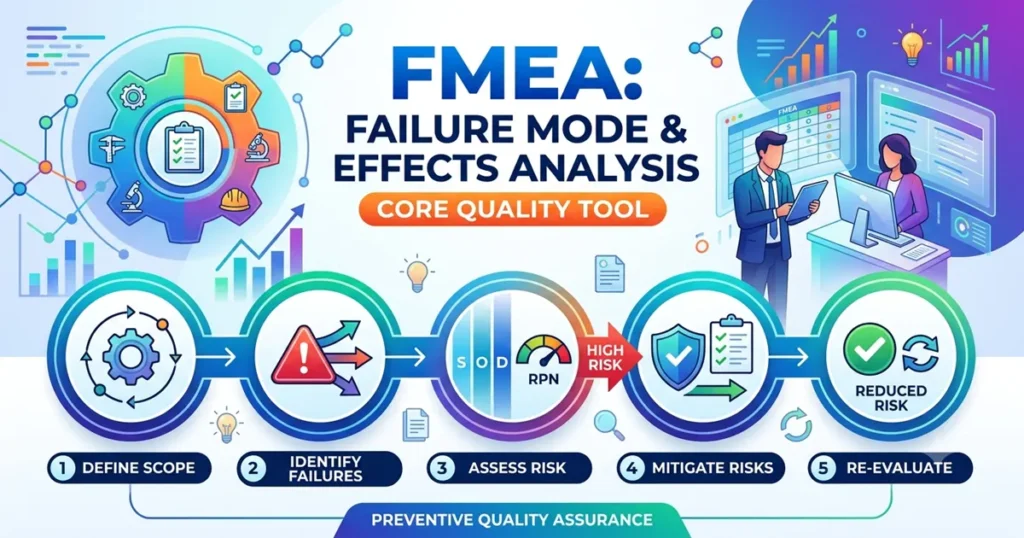
Failure Mode Effects Analysis (FMEA): Core Quality Tool
It is a proactive approach, which help us to find out/ to identify potential problems or failures, their causes and their resulting effects on the system or process. And then to eliminate those failure so that no undesirable event occurs.
Table of Contents
ToggleWho Performs FMEA?
Failure Mode Effects Analysis is not the responsibility of a single person or only the quality department. In this CFT works (Cross Functional Team). It is a team effort involving people from different departments, such as Tool Room, Production, Maintenance, and Quality. Each team member brings their own experience and knowledge to identify potential failures and find ways to prevent them. Feedback from contractors and customers can also be valuable in making the FMEA more effective.
Outcome of FMEA
- Identify design/ process failure modes before occurance.
- FMEA determines the effect and severity of those failure modes.
- FMEA identifies the cause and probabilities of occurrence of failure modes.
- FMEA identifies the controls and their effectiveness
- FMEA prioritises the risk associated with the failure modes.
- FMEA develops action plan to reduce risk.
Steps to perform FMEA
- Describe the product function or purpose of the process.
- What are the potential failures:
Failure in component, system, sub-system or in process. - Effect of these failures:
Improper appearance of the product/ process, malfunction of product/ process, reduced performance, injury/ death. - What is the severity of effects:
Scale: 1 to 10;
where, 1: low effect,
and 10 indicates the failure of system, process, safety, without warning. - What are the causes of each failures:
The potential causes for each failure should be identified and documented. eg. corrosion, improper alignment, excessive delay. - How likely is to occur: (defect occurance)
Scale 1 to 10;
where 1 not likely,
and 10 is inevitable (defect occurs) - What are our current controls:
Current controls are those which are preventing the failure mode from occurring before it reaches to the customer. - What is the likelihood of detecting the problem:
How much current controls detecting the cause of failure.
Scale 1 to 10;
where 1 is very likely,
10 indicates that the problem will never be detected. - Calculate the Risk Priority Number (RPN):
RPN= Severity (S) X Occurrence(O) X Detection (D)
RPN used to prioritise items then required additional action. - Address the biggest issue first:
That have high RPN (typically top 30% are targeted),
Action taken on: inspection procedure, selection of different components, material, supplier, or re-design the product. - Who is going to complete the action plan and when will be done:
Assign responsibility and target completion date for decided actions. - Follow up:
After the action has been taken, re-assess the severity, occurrence and detection and then revised the RPN.
Also, check if any further action reqruied? Update FMEA.
Advantage of FMEA
Following are the benefits of FMEA in any design or process.
- Excellent technique of preventive action
- Continuous improvement (never ending)
- Collective knowledge of team (cross functional team-CFT works)
- Improve the quality, safety and reliability of process.
- Reduce process develop time and cost.
- Provide historic records
- It is in document form so we can track risk reduction activities.
- Increase customer safety and satisfaction.
Types of FMEA
- Design FMEA (DFMEA)
- Process FMEA (PFMEA)
| Point | DFMEA | PFMEA |
|---|---|---|
| Full Form | Design Failure Mode and Effects Analysis | Process Failure Mode and Effects Analysis |
| Focus | Product design | Manufacturing process |
| Purpose | To identify and prevent failures due to design weaknesses | To identify and prevent failures due to process weaknesses |
| When Performed | During product design and development | During process planning and before or during production |
| Who Performs It? | Design, Engineering, Quality, Testing, and other relevant team members | Production, Process Engineering, Quality, Maintenance, Tool Room, and other relevant team members |
| Main Question | What could go wrong because of the product design? | What could go wrong during manufacturing or assembly? |
| Example | A shaft is designed with insufficient diameter to withstand the required load | A shaft is manufactured with an incorrect diameter due to improper machine settings |
| Possible Causes | Incorrect design dimensions, unsuitable material, or weak design | Incorrect machine settings, tool wear, or improper work methods |
| Preventive Actions | Modify the design, dimensions, material, or geometry | Improve machine settings, tooling, work instructions, or process controls |
| Main Objective | To ensure the product is designed correctly | To ensure the product is manufactured correctly |